
Rules
ADA Compliance for Social Platforms: What US and Canadian Users Should Know
ADA compliance for social platforms explained for US and Canadian users, covering Title III, Section 508, captions, keyboard access, and rural connectivity effects.
ADA Compliance for Social Platforms: What US and Canadian Users Should Know
What to take away
- Title III of the ADA can cover social platforms as places of public accommodation, especially when core features block disabled users.
- US duties come from Title III, Section 508 procurement rules, and DOJ guidance, not from one statute that names Facebook or TikTok.
- Canada has no ADA clone, but the Accessible Canada Act, Ontario's AODA, and Nova Scotia's Accessibility Act shape platform use.
- Practical accommodations are edited captions, alt text, keyboard access, screen reader labels, and a clear barrier report path.
Who has to comply
Title III of the Americans with Disabilities Act (42 U.S.C. 12181 and following) applies to businesses open to the public, including online services in many enforcement actions. The ADA itself does not name Facebook, TikTok, or X. Coverage comes from how courts and the DOJ read public accommodation under the Title III regulation, 28 CFR Part 36, and the DOJ's 2022 "Guidance on Web Accessibility and the ADA". The starting point is Which Social Platforms Must Comply, because it maps Title III, federal contracts, and DOJ guidance.
Federal agencies and contractors also face Section 508 rules, which push accessible technology through procurement. Section 508 of the Rehabilitation Act applies to all federal agencies when they develop, procure, maintain or use electronic and information technology; recipients of federal funding answer to Section 504 instead. A platform that sells to a federal agency may need a VPAT or similar access report.
The technical benchmark is the Web Content Accessibility Guidelines (WCAG) at Level AA. The Revised 508 Standards, published by the US Access Board at 36 CFR Part 1194, require electronic content to conform to WCAG 2.0 Level A and Level AA. The DOJ's 2024 Title II rule set WCAG 2.1 Level AA for state and local government web content and apps. Title III has no adopted technical standard, so WCAG Level AA is the yardstick most private-sector audits and settlements use. A private platform with no federal contract still faces Title III claims if it serves the public.
What counts as an accommodation
An accommodation is not a separate app. It is a feature change that removes a barrier for disabled users. The DOJ web guidance says accessible design benefits people with visual, hearing, motor, and cognitive disabilities. DOJ web guidance treats online services as covered when they connect to a place of public accommodation.
Captions must be accurate, not auto-generated gibberish. Images need alt text that describes the content and function. Buttons need names that screen readers can announce. Videos need audio description when visual details carry meaning. Timed posts need pause or extend controls.
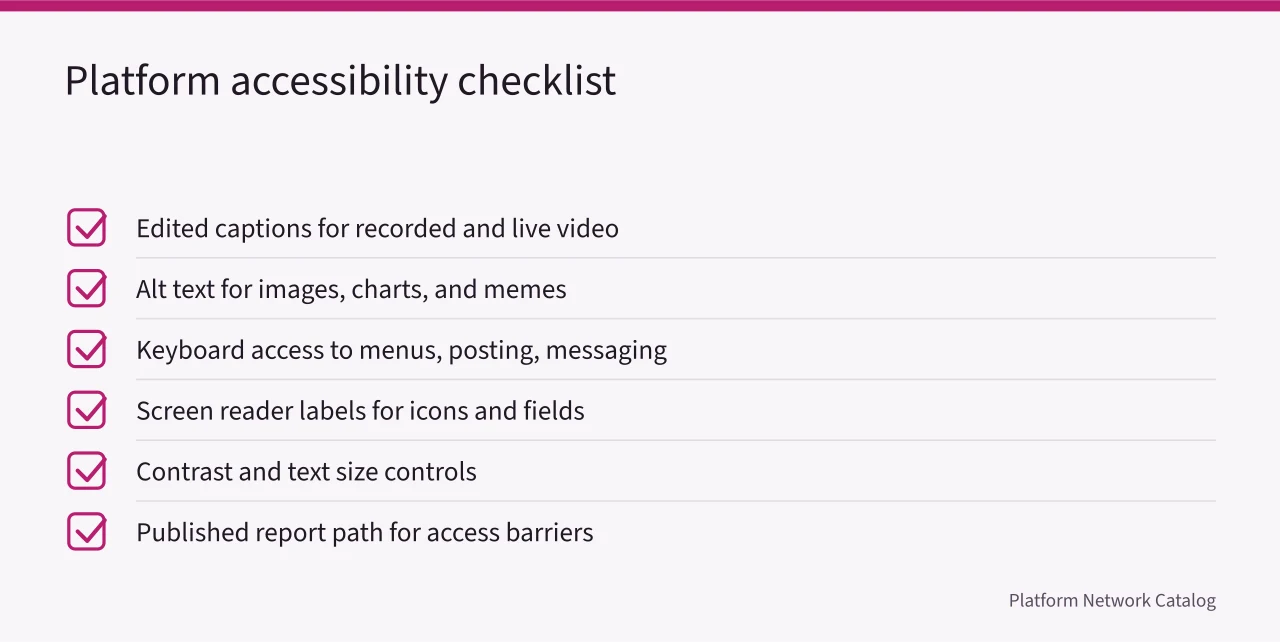
Checklist:
- Edited captions for recorded and live video
- Alt text for images, charts, and memes
- Keyboard access to menus, posting, and messaging
- Screen reader labels for icons and form fields
- Contrast and text size controls
- A published report path for access barriers
For a user, the list is a set of things you are entitled to ask for, whether the platform is Facebook, Instagram, TikTok, X, YouTube or LinkedIn. If a platform publishes an accessibility conformance report, often in the VPAT format, it is the platform's own statement of which of these features it claims to support, and a useful document to cite when one of them fails you.
Where US and Canadian rules meet
Canada does not have an ADA clone. The Accessible Canada Act covers federally regulated sectors like banking, telecom, and transport. The Accessibility for Ontarians with Disabilities Act, 2005 (AODA), whose Integrated Accessibility Standards set WCAG 2.0 Level AA for covered organizations' websites, The Accessibility for Manitobans Act, and Nova Scotia's Accessibility Act add provincial duties. Discrimination complaints run under the Canadian Human Rights Act federally and under provincial human rights codes, such as Ontario's Human Rights Code. For ICT, Accessibility Standards Canada has adopted CAN/ASC-EN 301 549, the Canadian version of the European ICT accessibility standard that itself incorporates WCAG.
A platform used by a Halifax nonprofit may fall under Nova Scotia rules for the organization, even if the platform itself is US-based. Rural connectivity in Halifax shapes which platforms groups can actually use, and the linked Atlantic Canada guide explains those coverage gaps.
Platform teams should map the user's location and the service's legal link to Canada. A US platform with Canadian users may need to answer both ADA claims and Canadian human rights complaints.
Example: captioning a live town hall
A Nova Scotia disability group hosts a live town hall on a social platform. The platform's auto captions drop words, lag, and miss names. The group adds a human captioner, posts a transcript, and assigns a moderator to read questions aloud. That change turns a video into an accessible event.
A platform feature is an accommodation only when a disabled user can complete the same task with the same independence and privacy.
Where a US or Canadian user can complain
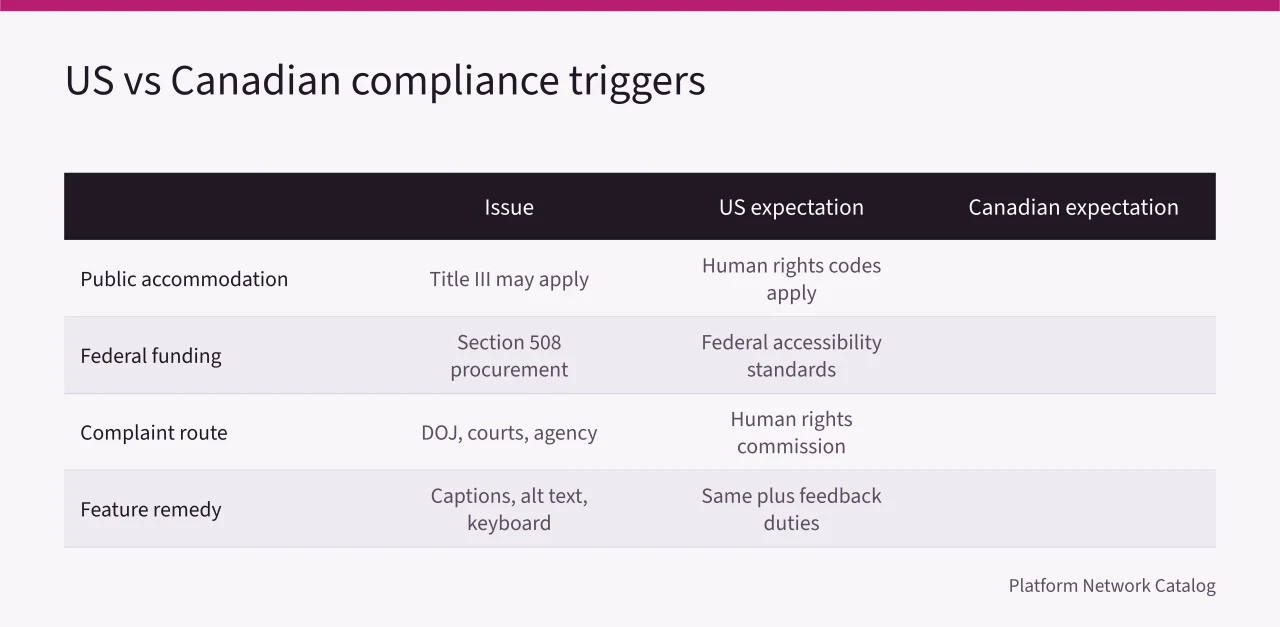
ADA platform compliance requirements often turn on captions and keyboard access, as the checklist above shows. Use this table to see which side of the border your complaint belongs on.
US expectation
- Public accommodation
- Title III may apply to online services
- Federal funding
- Section 508 procurement rules
- Complaint route
- DOJ, courts, or agency process
- Feature remedy
- Captions, alt text, keyboard access
Canadian expectation
- Public accommodation
- Human rights codes and accessibility laws apply
- Federal funding
- Federal accessibility standards for regulated sectors
- Complaint route
- Human rights commission or accessibility office
- Feature remedy
- Same features plus public feedback duties
The complaint bodies behind those rows: in the US, a Title III complaint goes to the Department of Justice's Civil Rights Division, filed online through its civil rights reporting portal at civilrights.justice.gov, or to federal court. A user filing should describe the platform, the feature that blocked them, the date and the assistive technology used. In Canada, federal complaints go to the Canadian Human Rights Commission, which also houses the Accessibility Commissioner for the Accessible Canada Act; in Ontario, applications go to the Human Rights Tribunal of Ontario; in Nova Scotia, to the Nova Scotia Human Rights Commission, with the province's Accessibility Directorate supporting the Accessibility Act.
- Write down the task you could not finishsigning up, posting, commenting, messaging or deleting.
- Note the date, the device and the assistive technology you used.
- Report the barrier through the platform's own access or help path and keep the reply.
- If nothing changes, file with the body for your side of the border named above.
- Keep copies of everything you sent and received.
What drives the effort and timing of ADA work
Effort varies by platform size and feature count. Common line items include captioning tools, human caption review, accessibility audits, developer time, and staff training. A small app may fix labels and contrast in days. A large platform with live video and complex feeds may need months.
Timelines also depend on legal pressure. A DOJ complaint or a human rights case can speed work. A voluntary audit can set a slower schedule. The money often goes to ongoing caption review, not a one-time code change.
What nobody mentions until afterwards
Accessibility fixes can change product metrics. Captions help users in noisy places. Alt text helps search and translation. Keyboard access helps power users. The hidden cost is moderation. Moderators must know how to handle access complaints without exposing private disability data.
Another hidden issue is rural bandwidth. A feature that works on fiber may fail on a slow mobile link. platform choice in Atlantic Canada can decide whether an accessibility feature reaches the user at all. If you rely on captions or a screen reader, say in your report whether the barrier appears only on a slow mobile connection.