
Rules
Platform data localisation Canada: storage versus control
Platform data localisation Canada explained through account, message, photo and moderation records, separating storage locations from legal control.
Platform data localisation Canada: storage versus control
What to take away
Platform data localisation Canada requires separating physical storage from legal control. This framework distinguishes record types; it is not a verified storage map for individual platforms.
- Account records can sit in US or Irish data centers even when the user is in Canada; location alone does not identify the entity that controls them.
- For Meta's Facebook and Instagram, Google's YouTube, TikTok, X, Snapchat, and Reddit, distinguish account records from Canadian advertising and billing records rather than assuming one entity controls everything.
- Canadian regions exist, including AWS ca-central-1 in Montreal, Azure Canada Central in Toronto, and Google Cloud northamerica-northeast1 in Montreal.
- Message content moves through content delivery networks and backups; identify the entity that possesses or controls the requested data.
- Photo metadata may stay on the device, in a Canadian bucket, or in a US processing pipeline, and each location has a different legal hook.
- Moderation logs may sit in a global tool that a Canadian subsidiary does not control.
- Criminal Code production orders and preservation demands concern data in the recipient's possession or control; storage location alone does not establish that relationship.
- PIPEDA, Quebec Law 25, the CLOUD Act, and the Online News Act apply to different records and actors.
Account records and platform records jurisdiction
Account records include email, phone number, login times, IP addresses, and device identifiers. A Canadian user's account may sit in a data center in Virginia, Oregon, or Dublin. The Canadian subsidiary may hold billing data, while the parent holds the core record.
The platforms Canadian readers ask about most are Meta's Facebook and Instagram, Google's YouTube, TikTok, X, Snapchat, and Reddit. For each service, distinguish the entity identified in its privacy policy from any Canadian operating company. Treat advertising and billing records, account records, login history, and IP logs as separate questions: a Canadian office is not evidence that all those records are stored or controlled in Canada.
The Personal Information Protection and Electronic Documents Act (PIPEDA) governs personal information handled in commercial activities within its scope, as the Office of the Privacy Commissioner of Canada explains.
A Canadian court can issue a production order to a platform with a Canadian legal presence. That order reaches records the Canadian entity controls. If the core record sits in the United States, the order may not reach it directly.
Canadian law provides two tools that reach these records. A production order under section 487.014 of the Criminal Code requires a person to produce data they possess or control, and a preservation demand under Criminal Code section 487.012, made in Form 5.001, requires a person to preserve computer data in their possession or control when the demand is made. Identify that possession or control before deciding whether assistance from another jurisdiction is needed; the storage country alone does not identify the proper recipient.
The CLOUD Act is part of the US framework for obtaining data from providers subject to US jurisdiction. On March 22, 2022, the two countries welcomed negotiations of a CLOUD Act agreement with Canada. That announcement does not establish that an agreement is in force. Canadian investigators can also seek US assistance under the Treaty between the Government of Canada and the Government of the United States of America on Mutual Legal Assistance in Criminal Matters; a CLOUD Act Canada review explains the US path.
The physical location often depends on the service architecture. Some platforms keep Canadian data in Canadian regions. Others replicate everything to US or European regions. The legal order must match the location and the entity.
The named Canadian regions are the ones a platform can actually choose: AWS ca-central-1 in Montreal, Microsoft Azure Canada Central in Toronto and Canada East in Quebec City, and Google Cloud northamerica-northeast1 in Montreal. A record placed in one of them is still controlled by whichever entity owns it, so a Canadian region does not by itself put the record in Canadian hands.
Message content and cross-border platform data requests
Message content includes text, attachments, reactions, and timestamps. Platforms often store messages in queue systems and object storage. Backups may sit in a different region from the live copy. Encryption keys may sit with the parent company.
Canadian investigators need the appropriate Criminal Code process to preserve data or obtain message content. When assistance from US authorities is needed, they can use a Canada–US mutual legal assistance treaty request.
Cross-border platform data requests may take months or years. The requesting state must follow the receiving state's law. The Office of the Privacy Commissioner of Canada accepts complaints about platform data handling.
Photo metadata and file-level clues
Photo metadata can include GPS coordinates, camera model, timestamp, and software edits. Platforms may strip EXIF on upload or keep the original file. A cloud bucket in Montreal is a different legal target than a bucket in Iowa.
The device can keep the only copy of the original metadata, and a service may process the file in another country and then discard the local copy. Photo platforms data walks through the fields that survive an upload, from GPS coordinates and camera model to timestamps.
For a Canadian order, identify the entity that possesses or controls the record as well as its storage location. A Canadian or US bucket address alone does not establish which entity can be required to produce its contents.
Moderation logs and Canadian platform data retention law
Moderation logs record decisions, policy versions, reviewer IDs, and timestamps. They often sit in a global trust and safety tool. The Canadian subsidiary may not control that tool. The parent company may hold the log in Ireland or the United States.
Canadian platform data retention law follows PIPEDA's principle of keeping personal information only as long as necessary. Quebec's Act respecting the protection of personal information in the private sector, amended by Law 25, requires destruction or anonymization once the purposes of collection or use are achieved, subject to statutory preservation requirements. It also assigns responsibility for protecting personal information within an enterprise, and the Commission d'accès à l'information enforces it. The Online News Act sets bargaining duties for large platforms, not data residency, but it shapes platform records in Canada.
No Canadian statute sets one retention period for moderation logs. A claim that a platform holds them for 90 days, a year, or longer needs that platform's current retention policy; those figures are not a Canadian statutory schedule. The retention schedule is a platform record itself, and a Canadian order can compel the schedule if the entity is subject to Canadian jurisdiction.
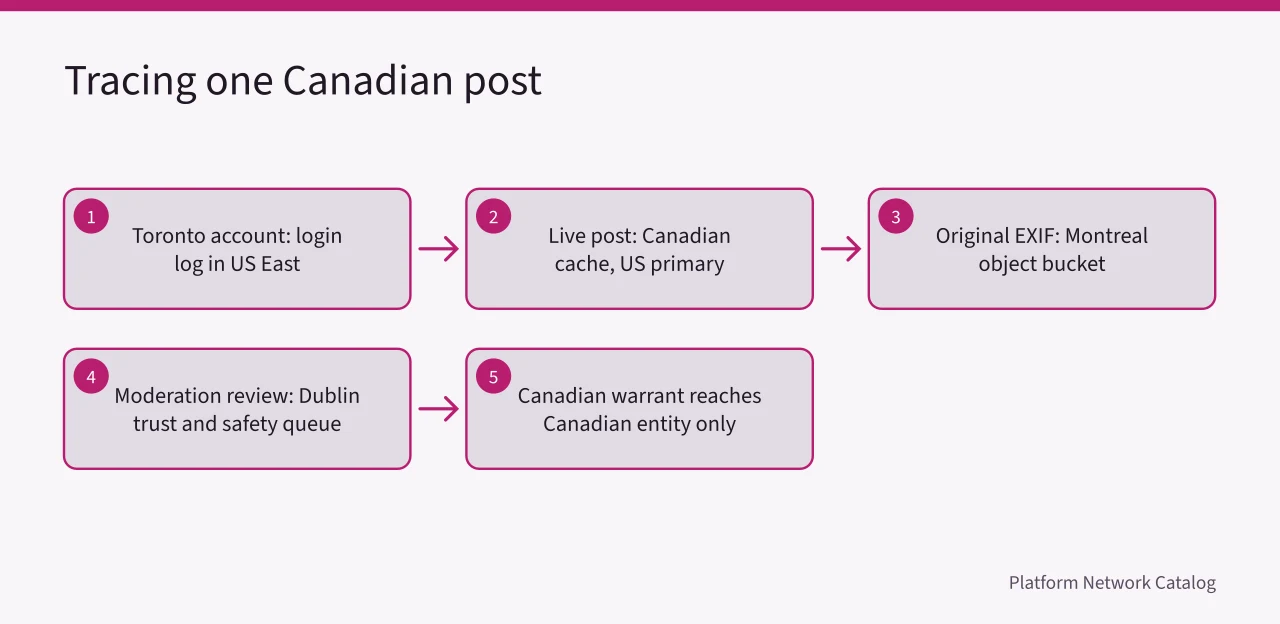
Example: tracing one Canadian post
Follow a hypothetical post from a Toronto account to see how records could split across borders. The locations below illustrate an architecture, not verified storage arrangements for any named platform.
- Account recordthe login log sits in a US East data center in Virginia.
- Message contentthe live post sits in an AWS ca-central-1 cache in Montreal and in a US primary store.
- Photo metadatathe original EXIF sits in a Montreal object bucket.
- Moderation logthe review entry sits in a Dublin trust and safety queue.
- Legal orderidentify which entity possesses or controls each record, then determine the applicable process and whether foreign assistance is needed.
Indigenous platform governance in Canada can set community data sovereignty rules. The OCAP principles — ownership, control, access, and possession — published by the First Nations Information Governance Centre are the framework most First Nations use when they write those rules.
First Nations, Inuit, and Métis models may require local storage, community consent, or language policies. A Canadian platform that serves these communities must map those rules alongside provincial and federal law.
Directory entries as supporting clues
Before citing a directory, check platform network catalog records for registration, privacy version, regulator reference, provinces and last-verified date.
These fields help date a catalog entry and locate its supporting documents; they are not proof of physical storage or legal control. Check the underlying privacy policy and entity information rather than treating the directory as an authoritative register. A stale entry can point to a different legal entity or a retired privacy policy, which changes which order reaches the copy.